
Court Marriage Delhi
Rohini · Tis Hazari · Advocate-Led
A clear, complete guide to court marriage in Delhi — what it is, which law applies, the documents, fees, age limits, notice period and same-day options — all on one page. Standard SMA route ₹6,100 · Same-day Arya Samaj ₹3,100 · Tatkal ₹12,000. Rohini Court & Tis Hazari Court. 100% government certificate.
Quick Answer · Updated 15 August 2026
Court marriage in Delhi is a legally valid marriage registered before a government Marriage Officer (the SDM), with no religious ceremony required. It is done under the Special Marriage Act, 1954 (any religion, 30-day notice, 30–45 days) or the Hindu Marriage Act, 1955 (registering an already-solemnised Hindu/Sikh/Jain/Buddhist marriage, same day–15 days). You need Aadhaar, date-of-birth proof, address proof, PAN, photos and 3 witnesses. The government fee is about ₹100 (HMA) or ₹15 (SMA); our advocate-led service packages are ₹3,100–₹12,000. It takes place at the SDM office (e.g. Rohini or Tis Hazari Court), 9:30 a.m.–1:00 p.m. on working days. Call 9891343962 for a free consultation.
Court marriage is a fully legal marriage that is registered before a government Marriage Officer (the SDM, or Sub-Divisional Magistrate) — without any big function, procession or compulsory religious ceremony. Both partners, of their own free will and in front of witnesses, sign a declaration, and the government issues a legal marriage certificate that remains valid for life. In simple words, court marriage means recording your marriage lawfully in the official government record.
In Delhi, a normal court marriage is carried out under two central laws, and which one applies to you depends on your religion and situation:
In both cases the Marriage Officer is the SDM office, working hours for this are 9:30 a.m. to 1:00 p.m. on working days, and the certificate is issued by the Delhi Government (Revenue Department). For reference, you can see the official page: Delhi Revenue Department — Marriage Registration. To understand the rules and compare the different legal routes, you can also read our court marriage rules & legal paths guide.
Not sure whether SMA or HMA applies to your case?
We will tell you in two minutes — just call or WhatsApp. The consultation is completely free.
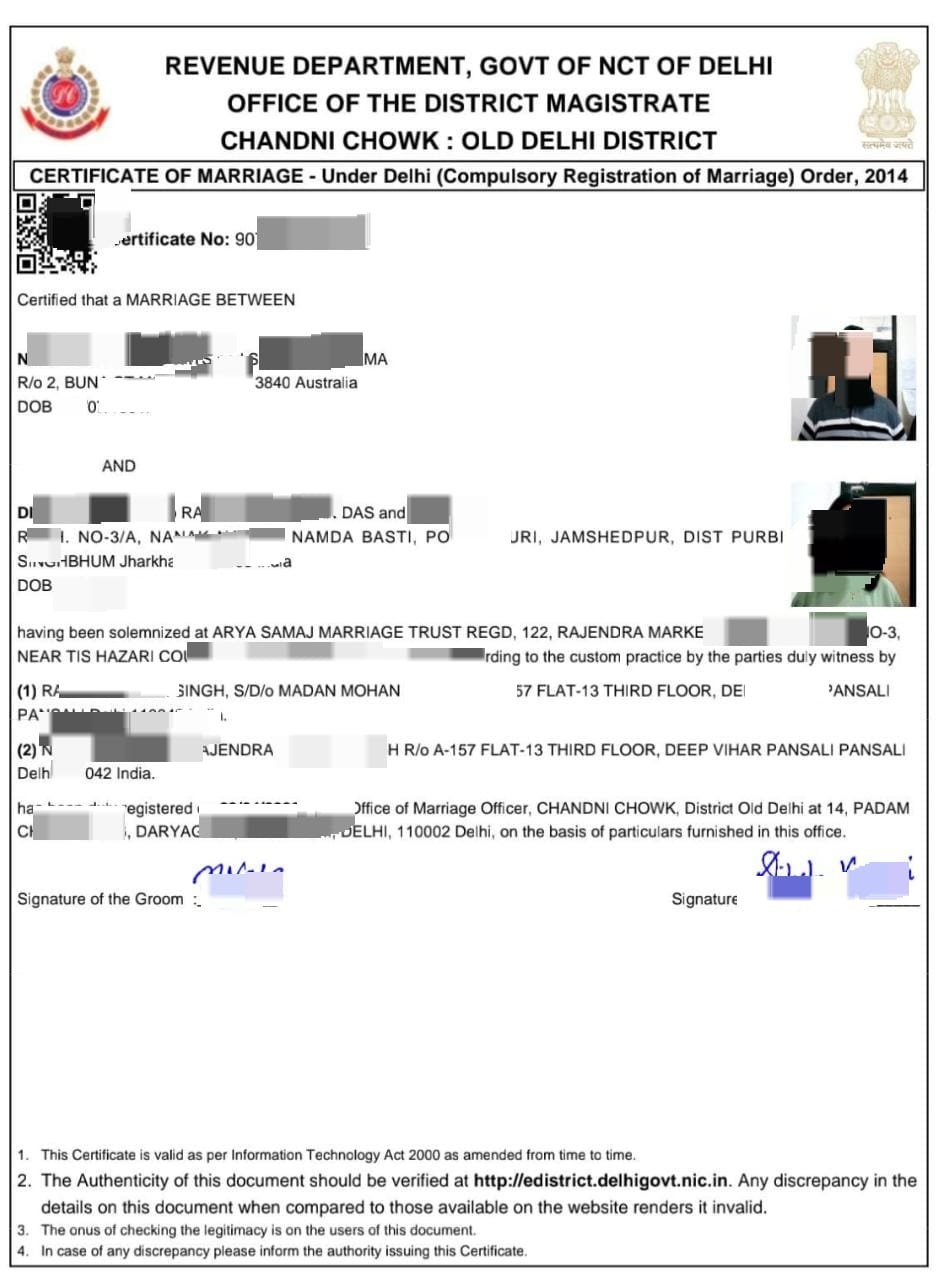
Many people believe that an Arya Samaj marriage is compulsory before a court marriage — this is not true. An Arya Samaj marriage is a separate, religious wedding (under the Hindu Marriage Act, performed with a sacred-fire ceremony and mantras). You only need it when:
You do not need an Arya Samaj marriage when:
A simple rule to remember: Arya Samaj is the fast Hindu-wedding option, while court/SMA is the most legally solid registration for every religion. The difference is explained further in Section 2 alongside the notice vs same-day comparison.
Yes, a foreign national can also do a court marriage in Delhi under the Special Marriage Act. The essentials are:
Two foreign nationals can also marry in India or Delhi under the Special Marriage Act — this needs both parties' documents and embassy certificates. (Note: for solemnisation in Jammu & Kashmir both parties must be Indian citizens — this restriction does not apply in Delhi.) A person from any other Indian state can comfortably do a court marriage in Delhi — you only need Delhi residence/stay proof for one party. For more detail, see our SMA / inter-caste page.
What if the bride is under 18 or the groom under 21? Such a marriage is not legally valid. Under the Prohibition of Child Marriage Act, 2006 it is voidable (the person who was a minor can have it annulled within two years of reaching adulthood). In serious cases — for example if a girl is enticed or taken away by deceit — the marriage is treated as void from the start. And an adult (18+) who marries a minor can face up to two years of rigorous imprisonment and a fine of up to ₹1 lakh. For this reason we never register an underage marriage — until both partners reach the legal age (bride 18, groom 21), we will advise you to wait and take the proper legal route.
What if someone marries using fake or forged documents? This is a very serious legal risk. A false age proof, a forged Aadhaar, or using someone else's ID amounts to forgery and cheating — it can get the marriage cancelled, and can lead to a criminal case and even jail under the BNS/IPC. Such a certificate is later rejected at passport, visa and court offices. Our policy is clear: we work only with genuine, verified documents — so that your certificate stays safe for life.
Sometimes one party changes their mind later or comes under family pressure. In such a situation we help in these ways: (1) proper documentation — at every step we keep signed forms, the affidavit and witnesses so that you hold legal proof; (2) if the marriage is already valid, help in obtaining certified copies; (3) if a partner is being forcibly held or threatened, legal guidance on a habeas corpus petition and a police complaint; (4) a free consultation with a senior advocate. We never force anyone to marry — we simply make sure your legal rights are protected.
This is absolutely clear — a court marriage is valid only when both partners give their free and willing consent. A marriage carried out without consent, through threat, deceit or force is void in law and is a crime. Both partners must give their consent personally before the Marriage Officer. If anyone is being forced, we do not register that marriage — instead we guide the affected person toward police protection and legal help. Forcing any couple is not part of our service; we only register the lawful marriage of willing, adult partners.
Is your case a little different or complicated?
Don't worry — speak directly with a senior advocate and we will explain the right legal route.
This is where most people get confused, so here it is clearly. The law, the venue and the time depend on who the two partners are. Use the table for a quick answer, then read the short notes below it.
| Couple type | Which law applies | Usual time | Read more |
|---|---|---|---|
| Hindu + Hindu (also Sikh/Jain/Buddhist) | Hindu Marriage Act (register the ceremony) or Special Marriage Act | Same day – 15 days (HMA); 30–45 days (SMA) | Arya Samaj · Registration |
| Hindu + Muslim / any inter-religion | Special Marriage Act only (no conversion) | 30–45 days (notice period) | Inter-Caste / SMA |
| Inter-caste (same religion) | Hindu Marriage Act or Special Marriage Act | Same day – 15 days, or 30–45 days | Inter-Caste |
| Muslim + Muslim | Nikah under Muslim law, or Special Marriage Act | Same day (Nikah) / 30–45 days (SMA) | Muslim Nikah |
| NRI / Foreign national | Special Marriage Act | About 60 days (30 residence + 30 notice) | SMA details |
For two Hindu (or Sikh, Jain, Buddhist) partners there are two clean options. If the wedding ceremony has already happened, you simply register it under the Hindu Marriage Act — this is fast, usually completed the same day (with a Gazetted Officer present) up to about 15 days. If you want a quick ceremony and certificate together, the Arya Samaj route gives a same-day result. You may also choose the Special Marriage Act, but that adds the 30-day notice period. See marriage registration in Delhi for the registration route.
An inter-religion couple — Hindu–Muslim, Hindu–Christian, Sikh–Muslim, or any other mix — marries under the Special Marriage Act, 1954, and no conversion is required. The marriage is solemnised in the SDM (Marriage Officer's) office after a 30-day notice period, so the usual timeline is 30–45 days. This is the safest, strongest certificate for mixed-faith couples and is accepted everywhere. Full details are on our inter-caste / Special Marriage Act page.
An NRI marrying an Indian, or a foreign national, marries under the Special Marriage Act. The foreign partner needs a passport with a valid visa, proof of at least 30 days' stay in Delhi, and a marital-status certificate (NOC) from their embassy. Because the 30-day residence and the 30-day notice run one after the other, a foreign national should plan for roughly 60 days in India. Two foreign nationals can also marry here under the SMA (with a Jammu & Kashmir exception). We handle the embassy NOC, apostille and worldwide certificate courier — see the SMA page for more.
Not sure which law fits your couple type?
Tell us both partners' religions and we'll confirm the exact route, venue and timeline.
To register a court marriage, a few basic conditions must be met:
This is the part that confuses people the most, so here it is in plain terms:
Important legal update: In the Safiya Sultana (2021) case, the Allahabad High Court held that the Special Marriage Act's 30-day notice publication is now optional, not mandatory — because publicising a couple's names goes against their right to privacy and liberty. Different SDMs may implement this differently, so we confirm what is possible in your case based on the specific office.
Need your certificate quickly?
Tell us your deadline — we will look at your religion and documents and confirm the fastest legal route.
The good news is that the documents are simple. Here is the complete checklist — the same is required from both the groom and the bride:
The government fee for registration is very low — about ₹100 under the Hindu Marriage Act and ₹15 for Special Marriage Act solemnisation (Delhi Revenue Department). You can view the official document/affidavit forms here: Revenue Department — Marriage Registration, and apply online at edistrict.delhigovt.nic.in.
Under the Special Marriage Act, three witnesses are required. (Under Hindu Marriage Act registration it is usually two or three, plus a Gazetted Officer who attended the wedding.) The rules for witnesses:
If arranging witnesses is a problem for you, just call and ask — we will suggest the best option for your case.
First, a common question: "is a wedding ceremony required before a court marriage?" — the answer depends on the law. Under the Special Marriage Act the marriage is performed in the office itself, so no prior ceremony is needed. Under the Hindu Marriage Act it is a "registration", meaning the ceremony must have already taken place. In both cases, the legal process of registration/declaration is as follows:
Call 9891343962 or WhatsApp us. We understand your case and send you the exact document list. Completely free.
Visit the Rohini or Tis Hazari office. We verify documents, prepare the affidavit and fill the application form (about 30–45 minutes).
The notice of intended marriage is filed before the Marriage Officer (SDM). A 30-day notice under SMA; a direct date under HMA.
On the fixed date, both partners appear with 3 witnesses before the SDM and sign the declaration.
The marriage certificate is issued — certified copies plus a digital copy on WhatsApp. Valid for life.
So the sequence is simple: apply / notice → (notice period, if applicable) → registration with witnesses → certificate. Registration is the step that legally records your marriage.
Let's separate the two costs clearly, because people often mix them up.
1) Government fee (paid to the Delhi Government): this is very low — about ₹100 for registration under the Hindu Marriage Act and ₹15 for solemnisation under the Special Marriage Act (Delhi Revenue Department). This is an official challan/receipt fee only.
2) Service fee (what we, as your advocate/consultant, charge): this covers the affidavit drafting, stamp paper and notary, documentation, application filing, advocate assistance and full coordination at the SDM office. It is a single, fixed, all-inclusive package with no hidden charges. Our packages start at ₹3,100 (Arya Samaj same-day), ₹6,100 (standard court marriage), and go up to ₹12,000 (Tatkal urgent) and ₹7,000+ (NRI/Foreign).
When do you pay? Usually a small advance at the start (to begin the affidavit and documentation) and the balance once the work is complete and your certificate is ready. Payment is accepted by cash, UPI or bank transfer, and the exact amount is confirmed to you upfront — so there are no surprises later. Full details are on our pricing page. Quick overview:
Add-ons (only if you need them): a police-protection coordination add-on from about +₹3,000 if there is family opposition or a threat; a full High Court protection writ petition is a separate advocate service (indicatively ₹11,000–₹25,000 depending on complexity). NRI/foreign cases may add embassy-NOC and apostille support. The exact figure for your case is always confirmed on a free call — see the police-protection details in Section 9 below.
Your exact timeline depends on your religion, documents and route — a short call is enough for us to give you an accurate day count.
A court marriage is legally the same at both venues. Your case is handled at the SDM (Sub-Divisional Magistrate) office in whose area (jurisdiction) the husband or wife resides. Common venues:
Your local SDM office depends on your pincode/area. Check officially here:
If you prefer, just WhatsApp us your area — we will tell you the correct SDM office and nearest court, and handle the full coordination. We cover Rohini, Dwarka, Saket, Karol Bagh, Preet Vihar and the whole of Delhi NCR.
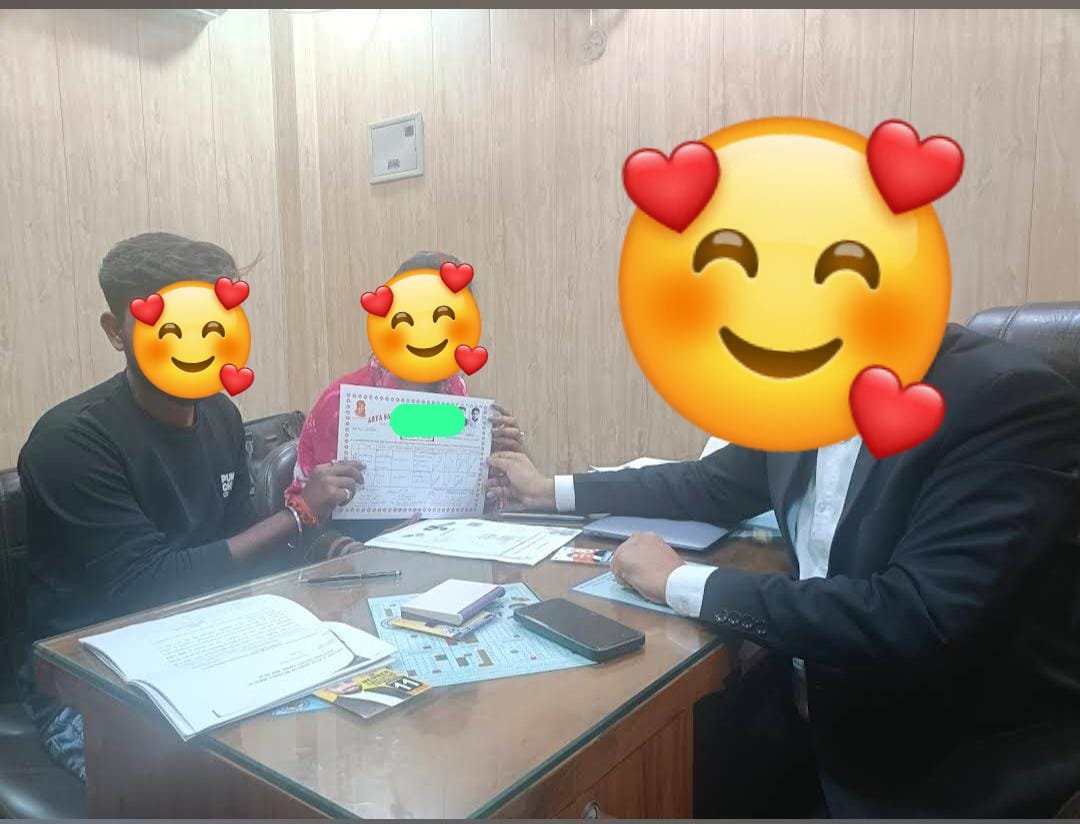
A very common question — and a fair one. A court marriage does not happen in a courtroom in front of a judge. It is done in the office of the SDM (Sub-Divisional Magistrate), who is appointed as the Marriage Officer for that area. This office usually sits inside the district court complex or the SDM/Tehsil/revenue office of the sub-division where the husband or wife lives — for example, at Rohini Court (Sector-14) or Tis Hazari Court. So "court marriage" simply means marriage before this government Marriage Officer. You appear at the SDM office with your documents and witnesses, sign the declaration, and the certificate is issued there. It cannot be done at home, a banquet hall or a temple — the legal signing must happen before the SDM (or, for a religious wedding, at an Arya Samaj temple which is a separate step). To find your exact office, use the official Find Your Sub-Division tool.
This is the single most confusing topic for couples, so let's settle it completely. There are three different things people mix up: an Arya Samaj temple marriage, the registration of that marriage, and a court (SDM) marriage. Here is what each one actually is.
What is an Arya Samaj marriage? It is a real, valid religious wedding ceremony performed at an Arya Samaj temple under the Arya Samaj Marriage Validation Act and the Hindu Marriage Act, with a sacred-fire ceremony and vows. It is available only to Hindu, Sikh, Jain and Buddhist partners. At the end you receive an Arya Samaj marriage certificate.
What is "Arya Samaj court marriage"? This phrase simply means doing the two steps together: first the Arya Samaj temple wedding (same day), and then taking that certificate to the SDM to register the marriage under the Hindu Marriage Act. The Arya Samaj certificate proves the ceremony; the SDM registration gives you the government marriage certificate. Many couples want this combined same-day route.
What is a court (SDM) marriage? Under the Special Marriage Act, the marriage is performed and registered directly in the SDM office — no temple and no religious ceremony, valid for every religion, but with a 30-day notice period.
| Point | Arya Samaj Marriage | Court Marriage (SMA) | Registration (HMA) |
|---|---|---|---|
| What it is | Religious wedding ceremony at temple | Marriage performed before the SDM | Recording an already-done wedding |
| Who can use it | Hindu/Sikh/Jain/Buddhist only | Any religion, inter-faith | Hindu/Sikh/Jain/Buddhist |
| Where | Arya Samaj temple | SDM office / court complex | SDM office |
| Notice period | None | 30 days | None |
| Time | Same day | 30–45 days | Same day – 15 days |
| Certificate | Arya Samaj certificate (needs SDM registration to become a government record) | Government certificate | Government certificate |
Arya Samaj temple marriage vs registration — the key point: the temple ceremony gives you a religious certificate, but for a government-recognised record (for passport, visa, bank, etc.) that marriage must still be registered with the SDM. So the temple wedding and the registration are two separate steps — we do both for you. Learn more on our Arya Samaj marriage page and the marriage registration page.
So which should you pick? If you are a Hindu/Sikh/Jain/Buddhist couple and want it fast and affordable, choose the Arya Samaj + registration route. If you are an inter-religion couple or want the strongest standalone certificate, choose court marriage under the Special Marriage Act.
Still confused between Arya Samaj and court marriage?
One quick call and we'll tell you exactly which one suits you — and why.
Most problems arise only from wrong information or incomplete documents. Common issues and their solutions:
The good part is that even if you are coming from another state or city, there is no difficulty — you only need Delhi stay/address proof for one party, and we handle the rest.
Some cases are a little sensitive. There is a legal, safe path for all of them:
Every adult couple has a constitutional right to marry a partner of their choice — the Supreme Court said this clearly in Lata Singh v. State of U.P. (2006) and Shakti Vahini v. Union of India (2018), and the Delhi High Court also repeatedly grants protection to couples. If there is family opposition or a threat, we help in these ways:
This means that even against family opposition you can marry legally and safely — you are not alone.
How many days does it take? A protection writ petition is usually drafted and filed within 1–3 working days once we have your documents. Urgent matters can be listed before the High Court within a few days, and truly urgent cases can sometimes be mentioned for next-day listing. A protection order directing the police to help is often obtained in about 1 to 2 weeks, depending on the court's board. A simple SHO representation (police station level) can be given the same day.
How much does the advocate charge? As an indication: a police-protection coordination add-on starts at about ₹3,000; a full High Court protection writ petition is typically ₹11,000–₹25,000, depending on how urgent and complex the matter is (drafting, filing, court fees and appearance). These are indicative figures — your exact, fixed quote is confirmed on a free call before any work begins, with no hidden charges.
Sometimes, after an SMA notice is published, word reaches the home or police station (an intimation), which troubles the couple. Ways to avoid this: (1) as per the Allahabad High Court (Safiya Sultana, 2021), the 30-day notice publication is now optional — we make exactly this legal request before the SDM; (2) where applicable, use the Hindu Marriage Act / Arya Samaj route, which has no public notice; (3) if a risk still remains, keep a protection petition ready alongside. Every case is different — we keep your privacy as a priority.
Family opposition or an urgent case?
Talk to us discreetly — a senior advocate will explain a safe, legal path. Your privacy is 100% respected.
A court marriage is an important legal step in life, so it should be done with someone you can trust. Couples choose Court Marriage Delhi for these reasons:
Below are experiences from a few couples who did their court marriage with us. (Some names are shortened for privacy.)
Q: Where does a court marriage happen — in a courtroom?
A: No. It takes place in the SDM (Marriage Officer's) office, which usually sits inside the district court complex or the sub-division revenue office — for example Rohini Court or Tis Hazari Court. There is no judge and no courtroom; you sign the declaration before the SDM with your witnesses, and the certificate is issued there. It cannot be done at home or a banquet hall.
Q: What is the difference between Arya Samaj marriage and court marriage?
A: An Arya Samaj marriage is a religious wedding ceremony at a temple (Hindu/Sikh/Jain/Buddhist only, same day). A court marriage under the Special Marriage Act is performed directly before the SDM, works for any religion including inter-faith couples, and has a 30-day notice period. An Arya Samaj wedding still needs SDM registration to become a government record — so many couples do both together as an "Arya Samaj court marriage".
Q: Which law applies to a Hindu–Muslim (inter-religion) couple?
A: The Special Marriage Act, 1954 — with no conversion needed. It takes about 30–45 days because of the notice period. See our inter-caste / SMA page.
Q: Which law applies to a Hindu–Hindu couple?
A: The Hindu Marriage Act (register the ceremony, same day to ~15 days) or the Special Marriage Act. The fastest option is usually an Arya Samaj marriage plus registration.
Q: How does court marriage work for an NRI or foreign national?
A: Under the Special Marriage Act, with a passport, valid visa, 30-day Delhi residence proof and an embassy NOC. Plan for roughly 60 days in India in total.
Q: How many days to get the certificate?
A: Same-day to 15 days via Arya Samaj / Tatkal / HMA registration; 30–45 days for a standard Special Marriage Act marriage.
Q: What is the government fee for court marriage?
A: About ₹100 (Hindu Marriage Act) or ₹15 (Special Marriage Act) paid to the Delhi Government; service/advocate charges are separate.
Q: Where is a court marriage certificate valid?
A: Across India, and at every bank, passport office, visa centre and foreign embassy — valid for life.
Q: Is the certificate available online?
A: You apply online at edistrict.delhigovt.nic.in; we provide both a digital and a certified physical copy.
Q: What are the SDM office hours?
A: Marriage work is done 9:30 a.m. to 1:00 p.m., on working days only.
Q: Is a wedding ceremony needed before a court marriage?
A: Not under the SMA (it happens in the office); yes under HMA registration.
Q: Can a second marriage be registered?
A: Yes — fully valid with a divorce decree or death certificate.
Q: Can it be done on a Sunday or holiday?
A: The SDM office is closed, but same-day help is possible via the Arya Samaj / Tatkal route.
The first step in a court marriage is one free call. Tell us about your case — your religion, both partners' ages, your documents and when you need the certificate — and we will tell you the right legal route and the exact cost in two minutes. Across Delhi NCR, for every SDM area. Wherever you are, we handle the coordination.
Rohini Court (Sector-14, Delhi 110085 · near Sector-18 Metro) · Tis Hazari Court (Delhi 110054)
Timing: Mon–Sat, 9:30 AM – 6:00 PM · Free WhatsApp consultation
Disclaimer: We are a private, advocate-led consultancy — not a government website or agency. Government fees are payable separately. You may also register directly at the Delhi Revenue Department or edistrict.delhigovt.nic.in. Final issuance of the certificate is subject to government norms and the Marriage Registrar's discretion.
100% genuine reviews submitted by real clients. Share your experience too.